Panel “How I survived my own leadership?”
On Monday, September 13, at the Metropol Hotel, a panel discussion “How I Survived My Own Leadership” was held for members of the Business Intelligence Club. The moderator of the event was Aleksandra Drecun, president of Intersection and director of the Harvard Alumni Association for Europe, and the speakers were Mr. Darko Budeč, founder and owner of Buck and Mr. Milan Gospić, director for Serbia, Microsoft.
In an informal atmosphere, we talked about success as the common denominator of two different development paths, about the joys it brings and the challenges that accompany it, about how dangerous leadership is, how to survive it, and where to find inspiration for always new positive changes in the lives of others, but and the meaning and fulfillment it gives to your own.
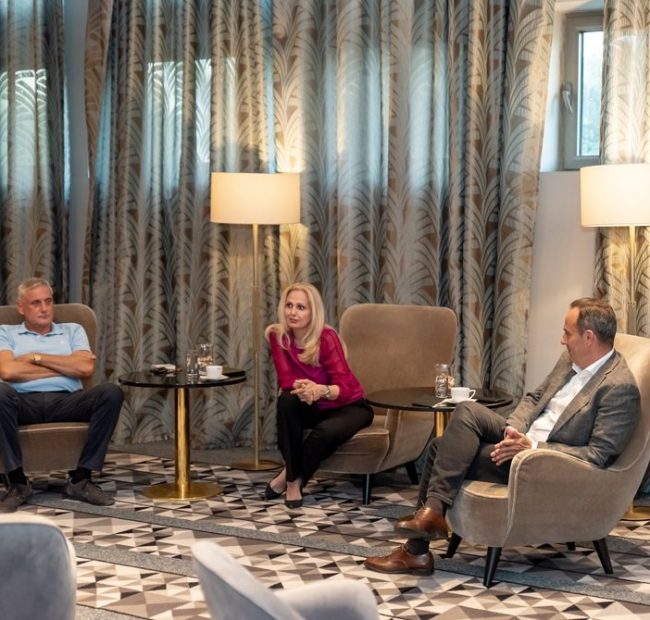
Darko Budeč, as the founder and owner of a company that has been operating successfully for over 25 years, points out that in his business it is extremely important to constantly keep up with technology that changes almost on a daily basis. For this reason, only a good organizational culture can be a guarantee for the implementation of the organizational structure, which must necessarily be well established in order for the company itself to be able to cope with numerous challenges in this field. As he states, innovation and the perception of an innovative product have become sociological problems due to man’s inability to select the ones that are important to him from a large amount of information. Today, the Buck company employs almost 100 employees, who work on product marketing in 54 countries on 4 continents, which makes this company stand out both on the domestic market and on the world market.
Milan Gospić pointed out that working in global companies has numerous advantages, especially when it comes to the provision of IT services, which today can be carried out from any location. As Milan Gospić states, the experience of working in large companies and living in different countries gave him the opportunity to see business from a wider angle, which gave him the opportunity to understand different organizational cultures and the requirements that this job entails. He believes that progress in the business sense does not always have to be down-top, but that it is also necessary to change positions on a horizontal level, because this provides numerous opportunities for improvement, and later the achievement of higher goals. He states that in the future Microsoft business center in Serbia has a tendency to become one of the four main centers in the world.